Quick Summary
Energy and mood shift with estrogen and progesterone across the cycle, and premenstrual fatigue has several overlapping causes. But evidence for cycle syncing is weak: a meta-analysis found performance differences between phases were trivial and rated the evidence low quality. Your own pattern beats any template.
Energy and mood are not steady across a month, and for anyone who menstruates a good part of that variation is predictable. Knowing which part is predictable — and which part the internet has invented — makes the pattern considerably more useful.
What Actually Changes, Phase by Phase
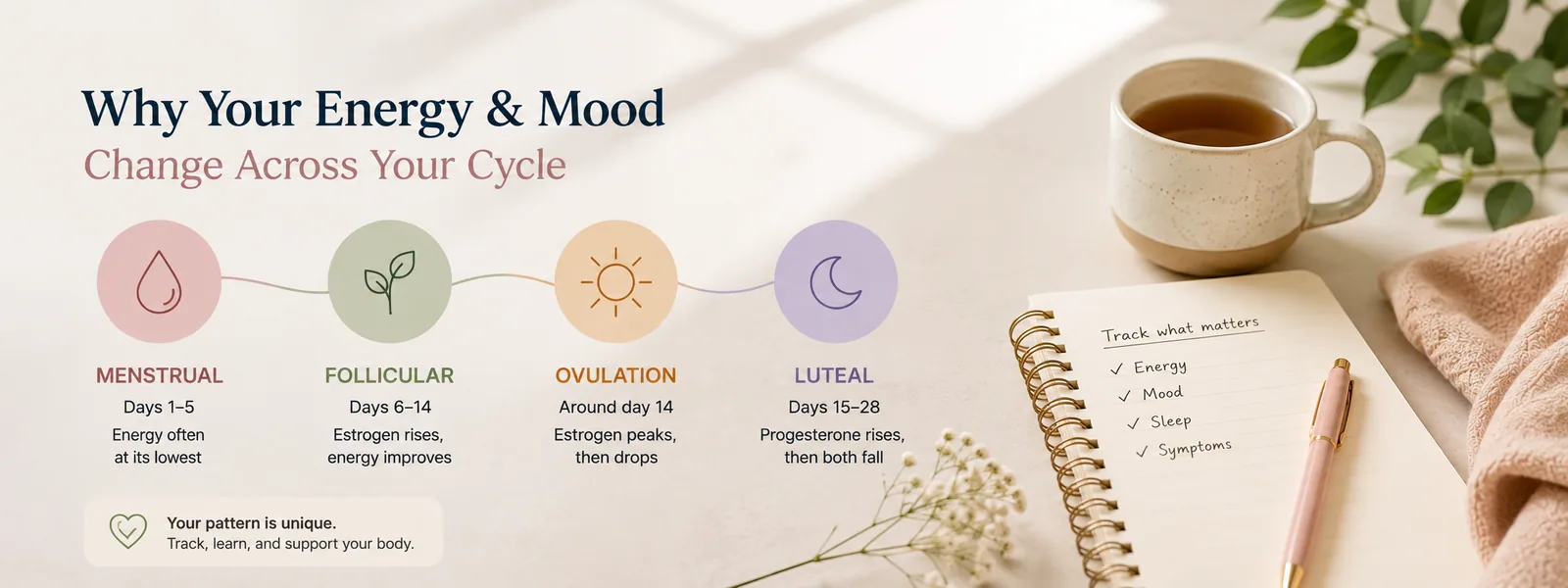
A cycle is usually described in three functional stretches, driven by two hormones moving at different times. Day one is the first day of bleeding, and cycle length varies enough between people that the day numbers below are a rough guide rather than a schedule:
| Phase | Roughly | What is happening |
|---|---|---|
| Menstrual | Days 1–5 | Both hormones low; bleeding; energy often lowest |
| Follicular | Days 6–14 | Estrogen climbing; energy and mood typically most stable |
| Ovulation | Around day 14 | Estrogen peaks, then drops sharply |
| Luteal | Days 15–28 | Progesterone rises, then both fall before bleeding |
The physical changes are measurable. Body temperature rises slightly after ovulation and stays up through the luteal phase, which is the basis of temperature-based fertility tracking. Subjective sleep quality tends to be at its worst around menstruation, even though the structure of sleep itself stays fairly stable.
The 28-day cycle is a textbook convention rather than a norm. Length varies between people and between months in the same person, and anywhere from about 21 to 35 days is considered ordinary in adults. That matters for tracking: a phase calculated from an assumed 28-day cycle can sit several days away from what your body is actually doing, which is how people end up convinced they are in the wrong phase for how they feel.
Why You're Tired Before Your Period
This is the most commonly asked question about the whole cycle, and it has a straightforward answer. In the late luteal phase, both estrogen and progesterone fall sharply. Progesterone has a sedative quality while it is high, and withdrawing it disturbs sleep. Estrogen influences serotonin activity, so its decline affects mood as well as energy.
The raised body temperature of the luteal phase works against you too, because falling asleep depends partly on core temperature dropping. Add heavier bleeding, which can deplete iron over time, and persistent premenstrual fatigue has several overlapping explanations rather than one.
There is a separate cause of cycle-linked fatigue that is not hormonal at all, and it is the one most worth ruling out because it is treatable. Menstrual blood loss depletes iron, and where periods are heavy the loss can outpace what diet replaces. The resulting iron deficiency produces fatigue that is easy to file under “it is just my cycle” — along with breathlessness on stairs, cold hands, poor concentration, and sometimes hair shedding or unusual cravings for ice.
The distinguishing feature is timing. Premenstrual fatigue is cyclical: it arrives in the luteal phase and lifts once bleeding is established. Iron-deficiency fatigue is constant, and typically worsens over months rather than tracking the calendar. It is also worth knowing that iron stores can be depleted while a standard full blood count still reads normal, so ferritin is the more informative test — and iron should not be self-prescribed, because excess is harmful and the cause of the loss matters more than the replacement.
Does Cycle Syncing Actually Work?
Cycle syncing — matching workouts, diet, and work to specific phases — is where the evidence stops keeping up with the confidence. The most rigorous look at the training half is a systematic review and meta-analysis of exercise performance across cycle phases.
It found performance might be trivially reduced during the early follicular phase. The pooled effect size was −0.06, which is close to nothing, the between-study variation was large, and the authors rated the overall quality of evidence as low. Their own conclusion was that general guidelines on exercise performance across the cycle cannot be formed, and that individual patterns are the more useful guide.
So the popular version — lift heavy in this phase, do yoga in that one — is prescribing from evidence that explicitly refuses to support a prescription. That is not the same as saying nothing changes. It means the average change is small, the variation between people is larger than the variation between phases, and a protocol built for everyone will not describe you.
What is reasonable is looser than a protocol. If you reliably feel weaker in the days before bleeding, moving a hard session is a sensible response to your own evidence. If you notice no difference, there is nothing to suggest you should manufacture one. The distinction is between adjusting to what you actually observe and following a calendar written for a body that is not yours.
Since the phase-matched protocols are not well supported, it is worth saying what does have evidence behind it for premenstrual symptoms specifically. Regular aerobic exercise across the whole month — not timed to a phase — is among the better-supported non-drug measures. Sleep regularity matters, and the luteal temperature rise makes a cooler bedroom more useful in that fortnight than usual. Reducing alcohol helps more than people expect, partly through sleep quality.
For symptoms severe enough to disrupt work or relationships, there are medical options rather than only lifestyle ones, including approaches that target the cycle directly. That is a conversation worth having rather than enduring, and it is the point at which self-management stops being the right tool.
What Tracking Is Actually Good For
The value is not in following a template. It is in producing your own data, because your pattern is the only one that reliably applies to you.
- Recognizing a low mood as cyclical rather than as a verdict on your life
- Scheduling demanding things around your own low days rather than a generic chart
- Spotting a change in cycle length or symptoms that is worth raising with a doctor
- Bringing dated records to an appointment, which is what a PMDD assessment requires
Two or three cycles of honest notes are worth more than any app's phase predictions. Apps estimate ovulation from past cycle lengths, and those estimates are frequently wrong for anyone whose cycles are not metronomic.
Keep the record small enough that you will actually keep it. Cycle day, energy out of five, mood out of five, how you slept, and anything notable — bleeding heaviness, pain, headaches. Five seconds a day for two months produces something a clinician can read and act on, which is more than any set of phase predictions will give them.
If You’re on Hormonal Contraception
Almost everything above describes a cycle driven by your own ovarian hormones. Hormonal contraception changes that picture, and the extent depends on the method — which is why phase-based advice often fits badly or not at all.
Combined pills, patches and rings suppress ovulation and supply hormone at a steady dose. There is no luteal phase in the physiological sense, and the bleed during the placebo week is a withdrawal bleed rather than a period. Symptoms that track that week are responding to hormone withdrawal, not to the cycle the app is drawing. Continuous or extended regimens, where the break is skipped, remove even that.
Progestogen-only methods vary more. The implant, injection and hormonal coil often suppress ovulation partially or completely, and bleeding patterns range from regular to absent. The copper coil is the exception in the other direction: it is non-hormonal, ovulation continues normally, and it can make periods heavier — which loops back to the iron question above.
The practical consequence is that a cycle-tracking app will keep predicting phases regardless, because most of them infer from dates rather than from physiology. If you are on hormonal contraception, the phase labels are decorative. Your own symptom record is still useful; the template laid over it is not.
When It's More Than PMS
Most premenstrual symptoms are unwelcome but manageable. Premenstrual dysphoric disorder is a distinct diagnosis: at least five specific symptoms in the final week before bleeding, resolving as it starts, severe enough to disrupt work or relationships. It is diagnosed from symptoms recorded prospectively over two cycles rather than remembered afterwards — which is the one situation where cycle tracking is genuinely diagnostic.
One last note on apps generally. Prediction from dates alone is an estimate, and it degrades when cycles are irregular — which is precisely when people most want the information. Treat the forecast as a rough expectation rather than a schedule, and weight your own logged symptoms above it when the two disagree. It is also worth reading what any app does with your data before you enter several years of it, since reproductive health records are not ordinary app telemetry.
Frequently Asked Questions
Why am I so tired before my period?
Estrogen and progesterone both fall sharply in the late luteal phase. Progesterone withdrawal disturbs sleep, falling estrogen affects mood and energy, and the raised body temperature of that phase makes falling asleep harder. Heavy bleeding can add iron deficiency on top.
Does cycle syncing your workouts actually work?
The evidence does not support phase-based prescriptions. A meta-analysis found any performance difference across cycle phases was trivial, with low-quality evidence, and the authors concluded general guidelines cannot be formed. Tracking your own response is more useful than following a template.
Which phase has the most energy?
Most people report the follicular phase, as estrogen rises after menstruation ends. But variation between individuals is larger than the average variation between phases, so your own pattern matters more than the typical one.
How long should I track my cycle before it is useful?
Two or three complete cycles is enough to see whether a pattern is real. A PMDD assessment specifically requires symptoms recorded prospectively across two cycles, so dated notes are more valuable than recalling how you felt.
What is the difference between PMS and PMDD?
PMDD is a formal diagnosis requiring at least five specific symptoms in the final week before bleeding that resolve once it starts and are severe enough to disrupt work or relationships. PMS covers milder premenstrual symptoms that do not meet that threshold.
References
- McNulty KL, Elliott-Sale KJ, Dolan E, et al. "The Effects of Menstrual Cycle Phase on Exercise Performance in Eumenorrheic Women: A Systematic Review and Meta-Analysis." Sports Medicine, 2020;50(10):1813-1827.
- American College of Obstetricians and Gynecologists. "Premenstrual Syndrome (PMS)." ACOG, 2021.
- American Psychiatric Association. "Diagnostic and Statistical Manual of Mental Disorders," 5th ed., text revision. APA Publishing, 2022.
- Office on Women's Health, U.S. Department of Health and Human Services. "Menstrual Cycle." OWH, 2021.