Quick Summary
Randomized trials show raising dietary linoleic acid does not raise inflammatory markers, and pooled analyses link it to lower cardiovascular disease and mortality. The oxidation concern is real but applies to commercial deep frying. Seed oils mostly track ultra-processed food, the likelier cause.
Few food arguments have moved as fast as this one. Seed oils went from unremarkable pantry staples to the single most blamed ingredient in the Western diet, largely through social media, and mostly without the research catching up to the confidence.
The short version: the central claim does not survive contact with the evidence, one narrower version of it does, and the reason seed oils correlate with poor health is real but is not the oil itself.
What Counts as a Seed Oil
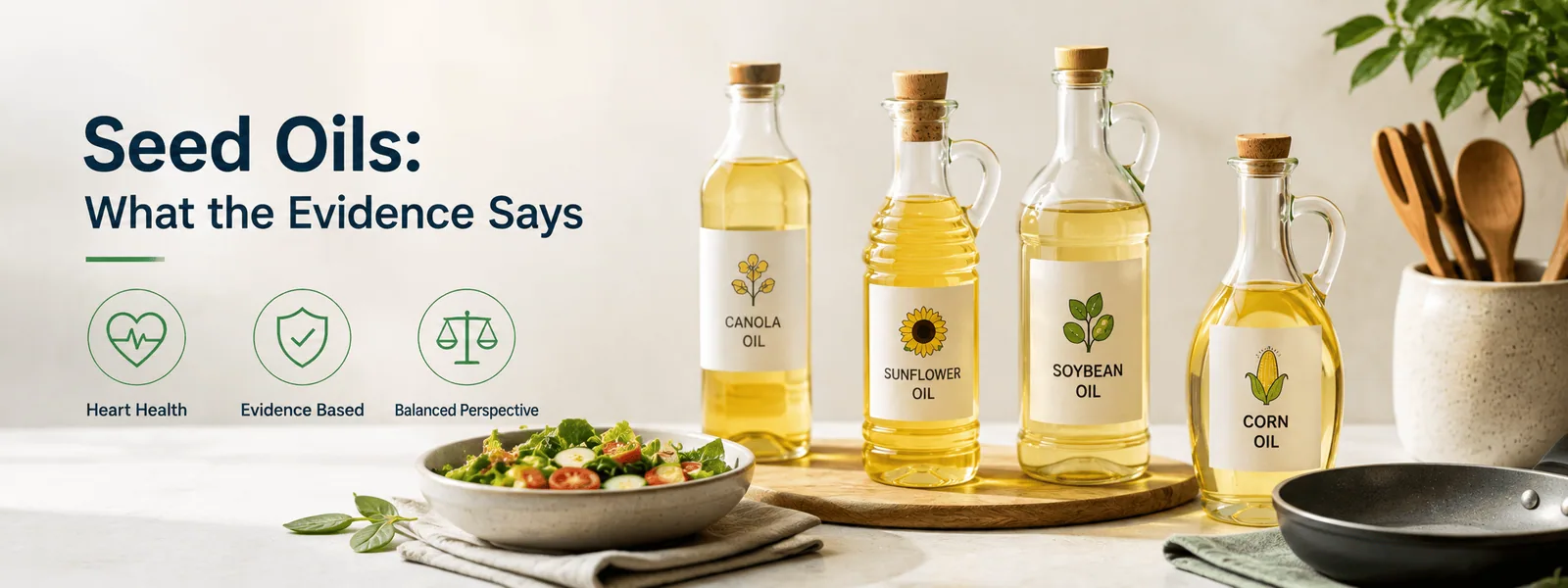
The term is culinary rather than scientific. In practice it means the industrially refined oils pressed from seeds — soybean, canola, corn, sunflower, safflower, cottonseed, grapeseed, rice bran. What they share is a high proportion of linoleic acid, an omega-6 polyunsaturated fat, and that is the fat the entire argument is about.
Linoleic acid is an essential fat: your body cannot make it and you need some. The question was never whether it is toxic, but whether the amounts in a modern diet are harmful.
Consumption did rise steeply. Seed oils were cheap, shelf-stable, and scaled alongside industrial food production through the twentieth century, displacing animal fats and later the partially hydrogenated oils that turned out to be genuinely harmful. That history is worth keeping in view: the last confident verdict delivered on a whole fat category was about trans fats, and seed oils are largely what replaced them.
How They’re Actually Made
A large part of the objection is not about linoleic acid at all. It is about processing — the sense that these are industrial products rather than food. That deserves a straight answer rather than a dismissal, because the process is genuinely industrial.
Most seed oils are extracted with a solvent, usually hexane, because pressing alone leaves too much oil in the seed to be economic. The oil is then refined, bleached and deodorised: degumming removes phospholipids, alkali treatment removes free fatty acids, bleaching clays remove pigments, and steam deodorisation at high temperature removes volatile compounds that would otherwise taste and smell strongly.
Two things are true about this at once. It is a heavily engineered process by any reasonable description. And the residual solvent in the finished oil is measured in parts per million against limits set with substantial safety margins, while the refining steps that trouble people are the same ones that make the oil neutral-tasting and stable enough to sit in a cupboard. Cold-pressed and unrefined versions exist for most of these oils; they cost more, taste stronger, and are less heat-stable, which is a trade rather than an upgrade.
Where this leaves you depends on what the objection actually is. If it is “solvent residue is harming me,” the measured quantities do not support that. If it is “I would rather eat less heavily processed food in general,” that is a coherent preference, and it is worth noticing that it is a preference about processing rather than a claim about linoleic acid — the two get argued as though they were the same position.
The Case Against Them
Taken at its strongest, the argument has three parts, and it is worth stating properly rather than dismissing:
- Linoleic acid converts to arachidonic acid, a precursor of pro-inflammatory signaling molecules
- Omega-6 intake has risen sharply in the last century, shifting the omega-6 to omega-3 balance
- Polyunsaturated fats are chemically fragile and degrade when heated hard or for long periods
The mechanism is real chemistry. Each step happens. The question is whether it produces the outcome claimed in actual people — which is a different question, and one that has been tested repeatedly.
What the Research Actually Found
Start with inflammation, because that is the load-bearing claim. A systematic review of randomized controlled trials examined what happens when you deliberately increase linoleic acid in healthy adults and measure inflammatory markers. Raising it did not raise them.
The observational evidence runs in the opposite direction from the claim as well. A pooled analysis of 30 cohort studies, covering nearly 69,000 people and more than 15,000 cardiovascular events, found that people with more linoleic acid in their blood had lower rates of cardiovascular disease, lower cardiovascular mortality, and less ischemic stroke. A separate meta-analysis of 38 studies and over 800,000 participants found higher linoleic acid intake associated with lower total, cardiovascular, and cancer mortality.
The omega-6 to omega-3 ratio deserves its own note, because it is the part of the argument that sounds most rigorous. Researchers have largely moved away from the ratio framing, because it hides what is actually happening — two people can share an identical ratio while eating wildly different absolute amounts of both. Where the two have been studied separately, the useful lever has consistently been raising omega-3 intake rather than cutting omega-6.
| The claim | What the evidence shows |
|---|---|
| Raises inflammation | Randomised trials: no increase in inflammatory markers |
| Causes heart disease | 30-cohort pooled analysis: lower CVD risk with higher levels |
| Increases mortality | 38-study meta-analysis: lower total and CVD mortality |
| Degrades when heated | True — and the one part worth acting on |
The ratio argument has a practical resolution that neither camp tends to reach for. If the concern is that omega-6 intake is high relative to omega-3, the response supported by evidence is to raise the omega-3 side rather than to chase the omega-6 side down — because the absolute intake of long-chain omega-3 is where the outcome data actually sits. Oily fish twice a week is the standard advice, and walnuts, flaxseed and chia contribute the shorter-chain form, which humans convert to the long-chain version inefficiently but not negligibly.
That framing also avoids an own goal. Cutting seed oils without replacing them tends to push people toward butter, lard and coconut oil, which raises saturated fat intake — and the evidence for replacing saturated fat with unsaturated fat is among the sturdier findings in cardiovascular nutrition. Solving a contested problem by worsening an uncontested one is not a gain.
Where the Concern Has Merit
The third part of the argument survives, with its scope narrowed considerably. Polyunsaturated fats do oxidize, and holding oil at frying temperature for hours generates aldehydes and other degradation products that nobody argues are good for you. This is established food chemistry, not a fringe position.
What it does not describe is your kitchen. The problematic scenario is oil kept hot for hours and reused repeatedly — a commercial deep fryer, not a pan you cooked in for eight minutes and washed. If this concern is what moves you, the useful response is eating less deep-fried takeout, not replacing the sunflower oil in your cupboard.
For cooking at home, the variables that matter are temperature, duration and reuse — in that order. A smoke point is a rough guide rather than a cliff edge, and refined oils generally tolerate more heat than unrefined ones, which is one of the few places where refining is unambiguously an advantage.
- Sautéing, roasting and baking: almost any of these oils is fine, including extra virgin olive oil, whose smoke point is comfortably above normal oven and pan temperatures
- High-heat searing and stir-frying: refined oils with higher smoke points — refined olive, avocado, peanut, or a refined seed oil — behave better than unrefined ones
- Deep frying at home: workable, but do not reuse the oil repeatedly, and discard it once it darkens, thickens or smells acrid, which are the signs of the degradation the research describes
- Dressings and finishing: extra virgin olive oil, where the polyphenols that survive no heating at all are the point
Storage does more than people expect. Light and air drive oxidation, so a bottle in a dark cupboard with the cap on lasts considerably longer than one left beside the hob. If an oil smells like crayons or old nuts, it has oxidised, and that is a real reason to throw it out regardless of which seed it came from.
Why the Association Looks Real Anyway
Here is the part both sides of the argument tend to skip. Seed oil intake really does track with worse health outcomes at a population level — because most of it is eaten inside ultra-processed food. Chips, cookies, fast food, packaged baked goods. Those foods are also high in refined starch, sugar, and salt, and low in fiber.
So the oil is a marker of a dietary pattern rather than a demonstrated cause of its effects. Someone who cuts seed oils usually cuts ultra-processed food at the same time, feels better, and credits the oil. The improvement is real; the attribution is the part that has not been established.
For cooking at home, the practical answer is unexciting: olive oil is the best-evidenced everyday choice, seed oils are fine for ordinary cooking, and none of it matters nearly as much as how much ultra-processed food is in the diet overall. If you enjoy butter, that is a separate conversation about saturated fat, not a rebuttal to this one.
Frequently Asked Questions
Are seed oils actually bad for you?
The main claims do not hold up well. Randomised trials show increasing linoleic acid does not raise inflammatory markers, and large pooled analyses link higher linoleic acid to lower cardiovascular disease and mortality rather than higher.
Do seed oils cause inflammation?
Trials that deliberately increased dietary linoleic acid in healthy adults found no rise in markers of inflammation. The mechanism sounds plausible on paper, but it has not produced the expected effect when tested in people.
Is it bad to cook with seed oils?
For ordinary home cooking, no. The oxidation concern applies to oil held at frying temperature for hours and reused, as in commercial deep fryers — not to a pan used briefly and then washed.
Which cooking oil is healthiest?
Olive oil has the strongest evidence base for everyday use. Seed oils are fine for regular cooking. The choice of oil matters far less than how much ultra-processed food the overall diet contains.
Why do people feel better after cutting seed oils?
Because cutting seed oils usually means cutting ultra-processed food, where most of them are eaten. The improvement is real, but the cause is more likely the change in overall diet than the removal of the oil itself.
References
- Johnson GH, Fritsche K. "Effect of Dietary Linoleic Acid on Markers of Inflammation in Healthy Persons: A Systematic Review of Randomized Controlled Trials." Journal of the Academy of Nutrition and Dietetics, 2012;112(7):1029-1041.
- Marklund M, Wu JHY, Imamura F, et al. "Biomarkers of Dietary Omega-6 Fatty Acids and Incident Cardiovascular Disease and Mortality: An Individual-Level Pooled Analysis of 30 Cohort Studies." Circulation, 2019;139(21):2422-2436.
- Li J, Guasch-Ferré M, Li Y, Hu FB. "Dietary intake and biomarkers of linoleic acid and mortality: systematic review and meta-analysis of prospective cohort studies." American Journal of Clinical Nutrition, 2020;112(1):150-167.
- American Heart Association. "Dietary Fats and Cardiovascular Disease: A Presidential Advisory From the American Heart Association." Circulation, 2017.