
Quick Summary
Brief night-time awakenings are a normal feature of sleep, not a disorder. REM-heavy sleep in the second half of the night makes you far more likely to notice and remember them, and cortisol begins climbing two to three hours after you fall asleep. What matters is not that you wake, but how long you stay awake.
If you wake at roughly the same time every night — often somewhere between 2 and 4 a.m. — the most likely explanation is not insomnia, not stress, and not your liver. It is the ordinary shape of a night's sleep, combined with the fact that you are far more likely to remember waking during the second half of it.
That doesn't mean nothing is wrong. But the useful question is not why you woke up, because almost everyone does. The question is why you stayed awake.
Waking Up at Night Is Normal — Here's What's Happening
Sleep is not one continuous block. You move through cycles of roughly 90 to 120 minutes, each descending into deep sleep and climbing back toward lighter stages before starting again. At the top of each cycle you come close to waking, and often you briefly do — for a few seconds, sometimes a couple of minutes. Most of these awakenings are never stored in memory at all.
What changes across the night is the mix. Deep, slow-wave sleep dominates the first half; REM sleep concentrates in the second. REM is a lighter stage and the one you are most likely to surface from and remember. That is why a 3 a.m. wake-up feels like an event and an 11 p.m. one does not — both happen, but only one gets recorded.
Why It Feels Like 3 A.M. Specifically
Cortisol, the hormone most associated with alertness, is not flat overnight. It reaches its lowest point around midnight and begins climbing roughly two to three hours after you fall asleep, building toward a peak in the morning. If you went to bed at 11 p.m., that rise is well underway by 2 or 3 a.m. Core body temperature is also near its nightly low around then, and the body has already begun the shift back toward waking.
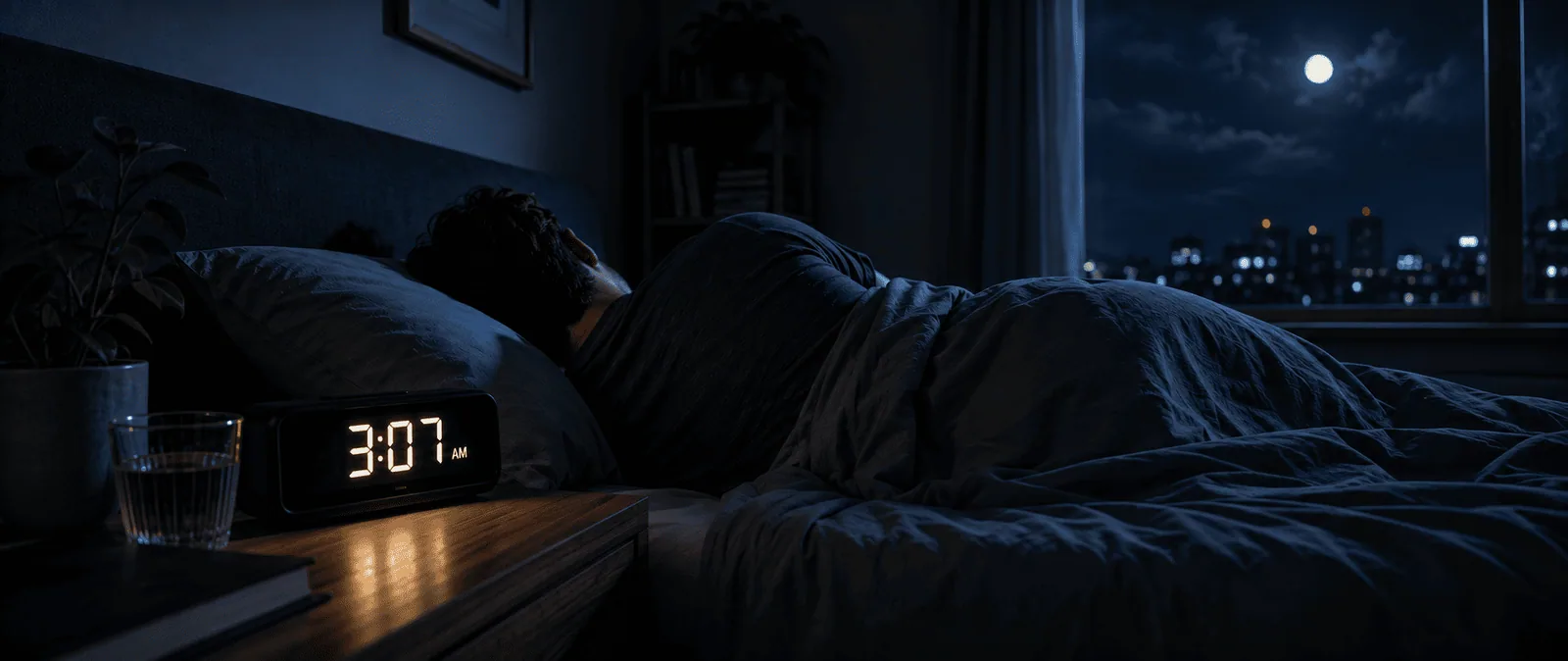
The clock does the rest. Once you have noticed 3:07 twice, you start checking — and a glance at the clock is enough to turn a forgettable awakening into a recorded one. The hour is real, but its apparent precision is largely a memory effect rather than a biological alarm.
What Turns a Two-Minute Wake-Up Into a Two-Hour One
This is where the real problem usually sits. Several common things make it harder to drop back under once you have surfaced:
- Alcohol in the evening, which consolidates the first half of the night and fragments the second
- A full bladder — nocturia is common and becomes more so with age
- A bedroom that is too warm, working against the overnight drop in body temperature
- Late caffeine, which has a half-life of around five hours in most adults
- Worry that arrives the moment you are conscious and escalates because there is nothing else to do
- Untreated sleep apnea, which fragments sleep without the sleeper ever knowing why
Alcohol Is the Most Common One
Alcohol is a sedative, so it shortens the time it takes to fall asleep and deepens the first half of the night. The second half is where it charges for that. A 2013 review of the polysomnography evidence found that at moderate doses alcohol suppresses REM sleep by 20 to 30 percent and significantly fragments the back half of the night — precisely the window a 3 a.m. wake-up falls in. The effect is dose-dependent, and it does not require anything close to intoxication.
How to Get Back to Sleep
The instinct is to stay in bed and try harder. That is the one approach with good evidence against it. Lying awake teaches your brain that the bed is a place where you are conscious and frustrated, and the association reinforces itself night after night.
Stimulus control says the opposite. Formalized by Richard Bootzin in 1972 and still one of the most validated techniques in sleep medicine, it holds that if you have been awake for roughly 20 minutes, you should get up: leave the bedroom, do something dull in low light, and return only when you feel sleepy. A 2024 systematic review and network meta-analysis confirmed its effectiveness within cognitive behavioral therapy for insomnia.
| Do | Don't |
|---|---|
| Get up after about 20 minutes awake | Lie there willing yourself back to sleep |
| Keep lights low and the activity boring | Check your phone, email, or the news |
| Go back to bed only when you feel sleepy | Go back on a schedule to try again |
| Get up at your usual time the next morning | Sleep in to make up what you lost |
In practice the sequence that follows from stimulus control looks like this. Give it about twenty minutes — judged by feel, not by looking at a clock, since checking the time is itself the problem. If you are still awake and starting to feel frustrated rather than drowsy, get up. Go to another room if you have one. Keep the light low and warm; bright overhead light tells your circadian system it is morning.
Then do something undemanding and mildly absorbing until you feel sleepy again — reading something you have read before works well, because it holds attention without generating momentum. Avoid anything with a scroll, a score, or a plot you need to follow. Go back to bed when you feel sleepy rather than when you decide enough time has passed, and repeat if it happens again.
The point of all this is not the activity. It is that lying in bed awake and frustrated teaches your brain to associate the bed with being awake and frustrated, and that association is what turns an ordinary awakening into a nightly one. Breaking it takes a few weeks of consistency, and it usually gets slightly worse before it gets better.
When the Waking Points to Something Medical
Most night waking is ordinary. Some of it is a symptom, and the pattern usually gives it away — what wakes you, what you notice on waking, and how you feel during the following day.
Obstructive sleep apnea is the most commonly missed. The airway narrows or closes repeatedly during sleep, and each event ends in a brief arousal you may not remember. The tell is rarely the waking itself: it is waking unrefreshed no matter how long you spent in bed, daytime sleepiness that does not match your hours, morning headache or a dry mouth, and — often the most useful evidence — a partner reporting snoring, gasping, or pauses in breathing. It is substantially underdiagnosed, and it is worth raising specifically, because it does not resolve with better sleep habits.
Several other patterns are worth naming:
- Nocturia — waking specifically because you need to urinate, repeatedly, rather than noticing a full bladder after waking for another reason
- Reflux, which often presents as waking with a cough, a sour taste, or a burning sensation, and tends to be worse lying flat
- Perimenopause and menopause, where hot flushes and night sweats fragment the second half of the night in particular
- Thyroid overactivity, which can present as waking hot, anxious, and with a racing heart
- Medications — some antidepressants, stimulants, beta-blockers, steroids and diuretics all affect sleep architecture or timing
- Anxiety and depression, where early-morning waking with an inability to return to sleep is a recognised pattern rather than a coincidence
None of these is diagnosable from an article, and several are treatable once identified. The reason to separate them from ordinary waking is practical: sleep hygiene advice aimed at the wrong problem produces months of effort and no improvement, which people tend to read as personal failure rather than a misdiagnosis.
When It's Insomnia, Not Just a Wake-Up
There is a clinical line. Insomnia disorder requires that the difficulty occurs at least three nights a week, has persisted for at least three months, and affects how you function during the day — despite adequate opportunity to sleep. Waking at 3 a.m. through a stressful week is not insomnia. Waking most nights since spring, and dragging through every afternoon because of it, is worth taking to a doctor.
If it is chronic insomnia, the first-line treatment is not medication. The American College of Physicians recommends cognitive behavioral therapy for insomnia as the initial treatment for all adults, on the evidence that it matches sleeping pills for effectiveness with fewer harms — and, unlike medication, keeps working after the treatment ends.
It is worth knowing what that recommendation involves, because “therapy for insomnia” sounds vaguer than it is. Cognitive behavioural therapy for insomnia is a structured programme, usually delivered over six to eight sessions, and it has specific components. Stimulus control is one of them. Sleep restriction — deliberately compressing time in bed to match the sleep you are actually getting, then extending it as efficiency improves — is often the most effective and the least intuitive. The cognitive part addresses the beliefs that keep arousal high, particularly catastrophising about the consequences of a bad night.
It outperforms sleeping medication over the long run, and unlike medication its benefit persists after the treatment ends. It is also available as digital programmes where in-person provision is scarce, which matters because scarcity of trained therapists is the usual reason people are offered a prescription instead.
Frequently Asked Questions
Why do I always wake up at exactly 3am?
The precision is mostly a memory effect. You surface briefly at the top of several sleep cycles a night, but you are far more likely to notice the ones in the REM-heavy second half. Checking the clock then fixes a specific time in memory, and you start expecting it.
Is waking up in the middle of the night a sign of something serious?
Usually not. Brief awakenings are a normal feature of sleep architecture and happen to good sleepers too. It is worth medical attention if it happens most nights for three months, or comes with snoring, gasping, night sweats, or frequent urination.
Should I get out of bed if I can't fall back asleep?
Yes, after about 20 minutes. This is called stimulus control and it is one of the best-validated techniques in sleep medicine. Lying awake strengthens the association between your bed and being conscious, which makes the pattern worse over time.
Does alcohol make you wake up at 3am?
Often. Alcohol helps you fall asleep faster and deepens the first half of the night, then fragments the second half as it clears. The effect scales with the dose and does not require heavy drinking to show up.
Is it bad to look at the clock when I wake up at night?
It works against you. Seeing the time prompts a calculation about how much sleep is left, and that arousal makes falling back asleep harder. Turning the clock away removes the trigger and the sense that the waking is precisely timed.
References
- Feriante J, Araujo JF. "Physiology, REM Sleep." StatPearls, 2023.
- Ebrahim IO, Shapiro CM, Williams AJ, Fenwick PB. "Alcohol and Sleep I: Effects on Normal Sleep." Alcoholism: Clinical and Experimental Research, 2013;37(4):539-49.
- Burgio KL, et al. "Prevalence and Correlates of Nocturia in Community-Dwelling Older Adults." Journal of the American Geriatrics Society, 2010.
- Bootzin RR. "Stimulus Control Treatment for Insomnia." Proceedings of the American Psychological Association, 1972.
- Verreault MD, et al. "The effectiveness of stimulus control in cognitive behavioural therapy for insomnia in adults: A systematic review and network meta-analysis." Journal of Sleep Research, 2024;33(3):e14008.
- Qaseem A, Kansagara D, Forciea MA, Cooke M, Denberg TD. "Management of Chronic Insomnia Disorder in Adults: A Clinical Practice Guideline From the American College of Physicians." Annals of Internal Medicine, 2016;165(2):125-33.