Quick Summary
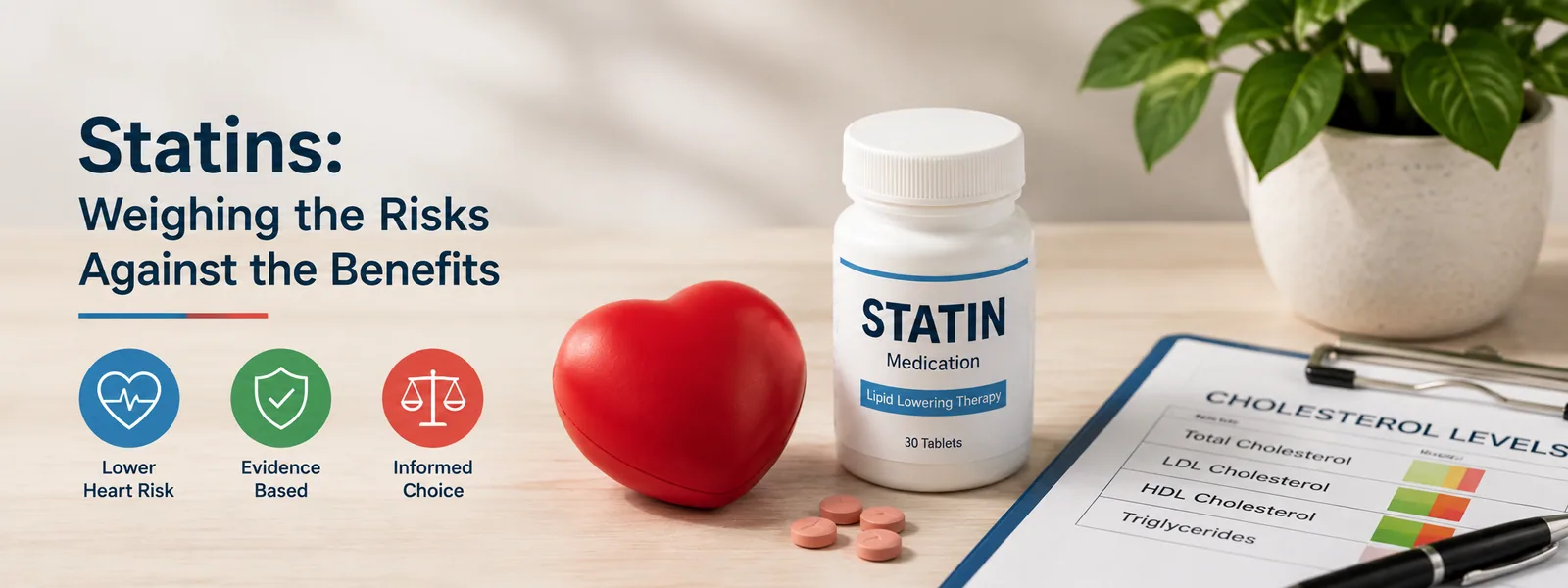
Statins cut major vascular events by roughly 21% per 1 mmol/L of LDL reduction, but the absolute benefit depends entirely on baseline risk. Blinded n-of-1 trials found around 90% of statin muscle symptoms also occurred on placebo. This is decision support, not advice — the choice belongs with your doctor.
Few medications are argued about as loudly as statins, and few decisions depend as heavily on the individual taking them. The same drug, with the same evidence behind it, offers a substantial benefit to one person and a marginal one to another.
This article covers what the trials found, which side effects hold up under testing, and the questions worth asking. It is not a recommendation either way — that decision belongs with you and your doctor, who can see your numbers.
What Statins Do
Statins reduce the liver's production of cholesterol, which lowers LDL cholesterol in the blood. Lower LDL means less of the material that accumulates in artery walls, and that is the mechanism by which they reduce heart attacks and strokes.
The size of that effect is unusually well quantified. Pooled analyses of trials involving well over a hundred thousand participants found that each 1 mmol/L reduction in LDL cholesterol corresponded to roughly a 21 percent lower rate of major vascular events, and that the proportional benefit was consistent across the different types of patient studied.
One distinction underlies almost every disagreement about statins, and it is rarely made explicit: whether you have already had a cardiovascular event. Secondary prevention means treating someone who has had a heart attack or stroke, or has established arterial disease. Their risk of a further event is high, the absolute benefit of lowering LDL is correspondingly large, and the evidence is strong enough that the argument is essentially settled.
Primary prevention means treating someone who has not had an event, to reduce the chance they ever do. Here the benefit is real but smaller in absolute terms, because the risk being reduced is lower to begin with — and that is where reasonable people, and reasonable guidelines, differ about where to draw the line. When you encounter two confident and contradictory claims about statins, check which population each is describing before concluding that one of them must be wrong.
Why the Same 21% Means Different Things
This is the part most arguments about statins fail to separate, and it explains how two people can read the same evidence and reach opposite conclusions. A 21 percent reduction is a relative figure. What it delivers depends entirely on how much risk you had to begin with.
| Your 10-year risk | Cut by about a fifth | People helped per 100 treated |
|---|---|---|
| 2 in 100 | roughly 1.6 in 100 | well under 1 |
| 10 in 100 | roughly 8 in 100 | about 2 |
| 30 in 100 | roughly 24 in 100 | about 6 |
The percentage never changes; the value of taking the drug changes enormously. Someone who has already had a heart attack is in the bottom row and the case is strong. Someone at low risk being offered a statin for prevention is nearer the top row, where reasonable people weigh a small absolute gain against taking a daily tablet for decades — and where guidelines are correspondingly more conditional.
Do Statins Cause Muscle Pain?
Muscle aching is the most reported reason for stopping statins, and it has been tested more rigorously than almost any other drug complaint — using n-of-1 trials, where each person cycles blindly through the drug, a placebo, and nothing, serving as their own comparison.
In one such trial of 60 people who had previously abandoned statins over side effects, symptom scores averaged 8.0 during months with no tablet, 15.4 during placebo months, and 16.3 during statin months. Ninety percent of the symptom burden that appeared on the statin also appeared on the placebo. A separate series of 200 n-of-1 trials in UK primary care found no difference in muscle symptoms between statin and placebo periods.
This needs stating carefully, because it is widely misreported. The symptoms are real — the placebo months produced roughly double the discomfort of the no-tablet months, which is not imagination. What the trials indicate is that in most people the drug is not what is causing them. That distinction matters, because it changes the options: a genuine drug effect calls for a different drug, whereas this pattern is often resolvable by other means.
In both trials, the results changed behavior. About half the participants in the first restarted statins afterwards, and two-thirds in the second had restarted or intended to.
The Risks That Do Hold Up
Not every concern dissolves under testing, and a fair account has to say so:
- A modest increase in the risk of developing type 2 diabetes, concentrated in people already close to the threshold
- Rhabdomyolysis, a serious breakdown of muscle tissue — genuinely dangerous and genuinely rare
- Raised liver enzymes, usually without symptoms and usually reversible
- Interactions with other drugs, which is why the full list you take matters
For someone at high cardiovascular risk, these are generally judged to be outweighed. For someone at low risk, that calculation is closer, which is precisely why it is a conversation rather than a formality.
One framing worth discarding is statin versus lifestyle. They are not competing for the same slot. Diet, activity, smoking status and blood pressure all move cardiovascular risk, and they move it whether or not you take a tablet — which also means improving them changes the baseline the whole calculation rests on. A decision made this year is not a permanent one.
If You Do Get Symptoms, What Happens Next
Discovering that most statin side effects do not survive blinded testing is cold comfort when your legs ache. The practical question is what to do about it, and there is a standard sequence — none of which is “stop and say nothing,” which is the most common response and the worst one.
- Pause and rechallenge: stopping briefly and restarting under supervision establishes whether symptoms actually track the drug, which is the n-of-1 logic applied informally
- Change the dose: a lower dose retains much of the LDL reduction, since the relationship is logarithmic rather than linear — doubling a dose adds far less than the first dose delivered
- Change the statin: these drugs differ in how they are metabolised and how far they penetrate muscle tissue, and people who cannot tolerate one often tolerate another
- Change the schedule: some statins have a long enough half-life to work on alternate days, which suits people whose symptoms are dose-related
- Change the drug class: where statins genuinely cannot be tolerated, other LDL-lowering options exist and are worth asking about rather than abandoning treatment
Blood testing has a limited but real role. Muscle enzyme levels can distinguish genuine muscle injury, which is rare, from aching without measurable damage, which is far more common. Liver enzymes are checked before starting and sometimes afterward. Neither test is done routinely at every visit in current practice, and asking for one is reasonable if symptoms are the issue.
Interactions matter more than most people realise, because several are pharmacokinetic rather than obvious. Some statins are metabolised by an enzyme system that grapefruit juice inhibits, which is why the grapefruit warning attaches to certain statins and not others. Some antifungals, some antibiotics, and certain other lipid-lowering drugs raise blood levels of the statin and with it the risk of muscle problems. This is precisely the kind of thing a pharmacist will check in a minute and is worth asking about whenever anything new is prescribed.
How to Have the Conversation
The most useful thing you can do is arrive with the right questions. What is my ten-year cardiovascular risk in absolute terms? What would it be on treatment? Is this primary prevention or secondary? If I get side effects, what are the alternatives — a different statin, a lower frequency, a non-statin option?
One thing not to do is stop a prescribed statin without telling anyone. If you have already had a cardiovascular event, stopping carries a real and quantifiable risk, and there are usually several options between continuing exactly as you are and abandoning treatment.
It helps to know that statins produce no sensation of working, which makes them psychologically unlike a painkiller. There is nothing to notice on a good day, so the only feedback available is a number on a lipid panel and the risk calculation sitting behind it. That absence of felt benefit, set against any side effect you do notice, is a large part of why so many people stop.
It also helps to name the asymmetry in how the two kinds of evidence reach you. Benefit is statistical and invisible: it is an event that did not happen, spread across years, and nobody experiences it. Harm is personal and immediate: a specific ache, in your specific leg, this week. Both are real, but they arrive through completely different channels, and the immediate one will always feel more substantial. Recognising that asymmetry does not settle the decision — it just stops one side of the ledger being weighed with a thumb on the scale.
Frequently Asked Questions
Do statins really cause muscle pain?
Usually not the drug itself. In a trial where people cycled blindly through statin, placebo and no tablet, 90 percent of the symptom burden on the statin also appeared on placebo. The pain is real, but in most cases the statin is not what is causing it.
How much do statins actually reduce heart attack risk?
Pooled trial data show roughly a 21 percent lower rate of major vascular events per 1 mmol/L reduction in LDL cholesterol. What that is worth depends on your starting risk — the same percentage delivers far more to someone at high risk than at low risk.
Should I take a statin if my risk is low?
That is a genuine decision rather than an obvious one, and it belongs with your doctor. At low baseline risk the absolute benefit is small, so guidelines are more conditional and personal preference carries more weight than it does at high risk.
Can I stop taking my statin if I feel fine?
Not without discussing it first. Statins do not produce a feeling of working, and stopping carries real risk for anyone who has already had a cardiovascular event. There are usually options between continuing unchanged and stopping altogether.
Do statins cause diabetes?
They are associated with a modest increase in the risk of developing type 2 diabetes, mostly in people already near the threshold. For those at high cardiovascular risk this is generally judged to be outweighed by the benefit, but it is a fair thing to raise.
References
- Cholesterol Treatment Trialists' (CTT) Collaboration. "Efficacy and safety of more intensive lowering of LDL cholesterol: a meta-analysis of data from 170,000 participants in 26 randomised trials." The Lancet, 2010;376.
- "N-of-1 Trial of a Statin, Placebo, or No Treatment to Assess Side Effects" (the SAMSON trial). New England Journal of Medicine, 2020.
- Herrett E, et al. "Statin treatment and muscle symptoms: series of randomised, placebo controlled n-of-1 trials." BMJ, 2021;372:n135.
- US Preventive Services Task Force. "Statin Use for the Primary Prevention of Cardiovascular Disease in Adults: US Preventive Services Task Force Recommendation Statement." JAMA, 2022.