
Quick Summary
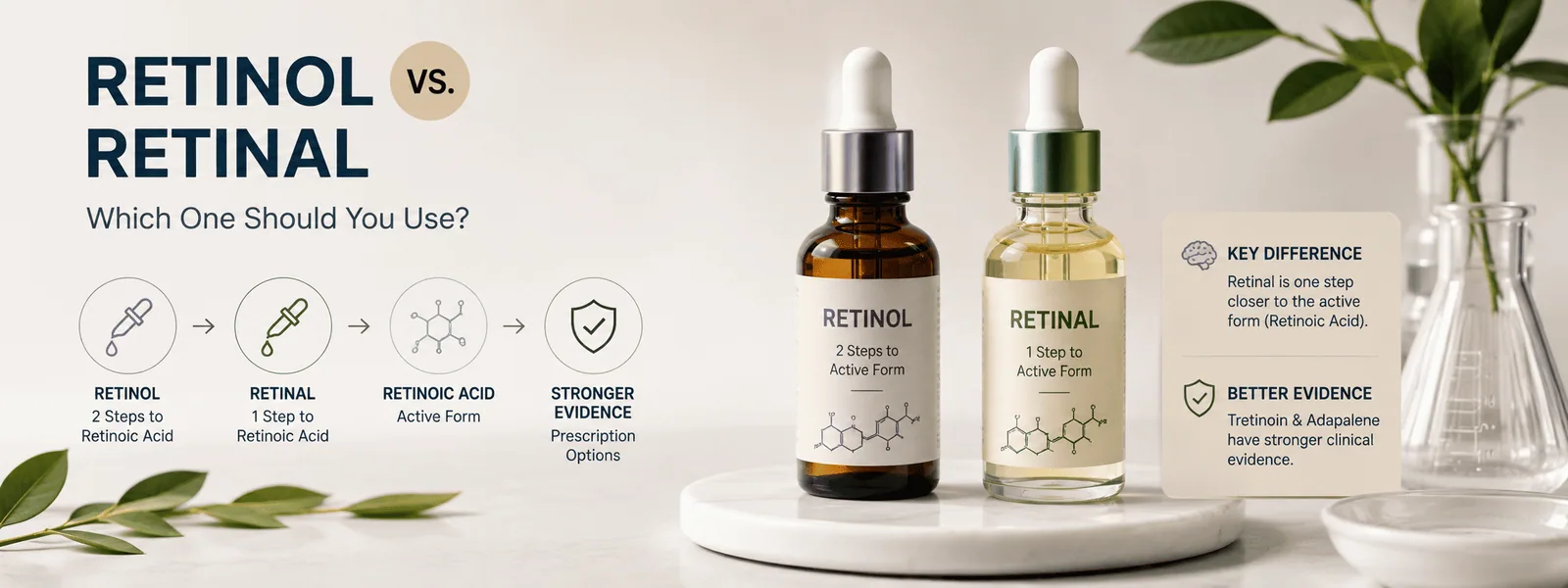
Retinal converts to active retinoic acid in one step, retinol in two. But a 2021 review of nine controlled trials found four showed no benefit over vehicle and the rest only weak evidence for fine lines. Prescription tretinoin and over-the-counter adapalene have far stronger evidence than either.
Retinol and retinal differ by one letter and one chemical step, and the skincare industry has built a great deal of marketing on that step. The chemistry behind the claim is genuine. Whether it produces a difference you would notice is a separate question, and a less flattering one.
The Actual Difference
Only one form of vitamin A does anything to skin: retinoic acid. Everything else is a precursor your skin has to convert, and each form sits at a different distance along the same chain:
- Retinyl esters — three conversions away, the weakest
- Retinol — two conversions away, the most common in cosmetics
- Retinal (retinaldehyde) — one conversion away
- Retinoic acid (tretinoin) — the active form, prescription only
So the marketing claim is directionally true: retinal is one step closer than retinol. What does not follow is that fewer steps translate into proportionally better results on a face, because conversion is not the only thing that limits how well these products work.
Several other factors matter at least as much. Retinoids degrade in light and air, so packaging and formulation can count for more than the molecule — an opaque, airtight pump protects an active that a clear jar slowly destroys. Concentrations vary enormously between products and are often undisclosed. How much reaches the living layers of skin depends on the vehicle it is suspended in. A well-formulated retinol can plausibly outperform a poorly formulated retinal.
The Uncomfortable Part
Before comparing the two, it is worth asking how well over-the-counter retinol works at all. A 2021 systematic review looked for randomized, double-blind, vehicle-controlled trials of over-the-counter vitamin A products for facial skin aging and found nine.
Four of the nine found no statistically significant difference between the retinol product and its vehicle — the same cream without the active ingredient. The other five showed what the reviewer described as weak evidence for a mild effect on fine lines only. All nine lacked proper endpoint designation, power calculations, and intention-to-treat analysis, and eight were industry-funded. The review's conclusion was that the positive trials were better suited to advertising than to clinical decision-making.
That reframes the question considerably. Arguing about whether retinal outperforms retinol assumes a solid baseline for retinol that the trial evidence does not clearly establish.
How They Compare in Practice
| Factor | Retinol | Retinal |
|---|---|---|
| Steps to active form | Two | One |
| Availability | Widespread, every price point | Fewer products, generally costlier |
| Irritation | Dose-dependent | Comparable at usual strengths |
| Trial evidence | Weak, mostly industry-funded | Thinner still — fewer trials exist |
The last row is the one worth sitting with. Retinal is newer and less studied, so choosing it over retinol means choosing the better mechanism and the smaller evidence base at the same time. That may still be a reasonable trade, but it is a trade rather than an upgrade.
Percentages do not transfer between the two either. A 0.1% retinal and a 0.1% retinol are not equivalent doses of the same thing, and neither maps neatly onto a prescription strength. Comparing the numbers on two different labels tells you remarkably little — which is awkward, given that the number is usually the largest thing on the box.
Because both molecules degrade on exposure to light and air, packaging is not cosmetic detail. An opaque tube or an airless pump protects the active; a clear glass dropper bottle or a wide-mouthed jar does not, and a jar additionally reintroduces air and fingers at every use. This is one of the few label-adjacent signals that reliably separates a formulation someone thought about from one that was assembled to a price.
The Options With Stronger Evidence
If the goal is a result rather than a routine, two products have a substantially better evidence base than anything in the retinol aisle.
Tretinoin is retinoic acid itself — no conversion required — and it is the most thoroughly investigated retinoid for photoaging by a wide margin. It needs a prescription in most countries, which is precisely why the cosmetics industry sells precursors instead. Adapalene 0.1% is a synthetic retinoid available without a prescription since 2016, and it has been tested against tretinoin in randomized trials for acne, with comparable results and better tolerability.
Note the different targets: adapalene's evidence is strongest for acne, while tretinoin's covers both acne and photoaging. Matching the product to what you actually want to change matters more than which precursor a serum contains.
There is a cost and access dimension that rarely appears in comparisons of these two molecules. Adapalene is available over the counter, is inexpensive, and has regulatory approval behind its acne indication. Tretinoin requires a prescription in most countries but is also long off-patent and correspondingly cheap where it is available. A well-formulated retinal serum, by contrast, is frequently the most expensive item in the routine.
That inverts the usual assumption that the pricier product is the stronger one. If budget is a real constraint, the sequence that makes sense is to establish whether you tolerate a retinoid at all using the cheapest effective option, and to treat a premium encapsulated retinal as a tolerability upgrade rather than a potency one — which is genuinely what it is, and a reasonable thing to pay for if irritation is what has defeated you before.
What the First Twelve Weeks Look Like
Most people abandon a retinoid in the first month, and almost always for the same reason: they expected improvement and got irritation. Knowing the shape of the timeline in advance is the single biggest predictor of whether someone is still using it when it starts working.
The first two to six weeks are retinisation — the skin adapting to accelerated cell turnover. Expect dryness, some flaking, tightness, and a degree of redness. It is not an allergic reaction and it is not the product being wrong for you, though it is worth saying that genuine allergy exists and looks different: swelling, intense itching, or hives rather than dryness.
Acne can worsen before it improves during this window. The mechanism is that faster turnover brings existing subsurface comedones to the surface sooner than they would have arrived on their own. It is self-limiting, and it is a reason to lower frequency rather than to stop.
Visible change in texture and tone generally begins somewhere around week eight to twelve. Effects on fine lines take longer still — trials in this area typically run twelve weeks or more, which is worth remembering when a product promises results in fourteen days. If nothing at all has changed after three to four months of consistent use at a tolerable frequency, that is a reasonable point to reconsider the product or step up to a prescription option, rather than at week three.
Using One Without Wrecking Your Skin
Whichever you choose, the application rules matter more than the molecule. Start twice a week rather than nightly and build up. Use an amount the size of a pea for the whole face. Expect an adjustment period of several weeks in which skin may flake or feel tight — that is expected, whereas burning, swelling, or persistent rawness is not.
Retinoids increase sun sensitivity, so daily sunscreen stops being optional. And give it time: trials measuring any effect run for months, not weeks. Judging a retinoid after two weeks tells you about the irritation, not the result.
One more practical point: retinoids do not need company. Layering them with exfoliating acids or vitamin C in the same routine is a reliable way to produce irritation that then gets blamed on the retinoid itself. If your skin is struggling, simplifying everything around it usually helps more than switching to a different retinoid.
Two techniques make the adaptation period considerably easier. The first is frequency: start twice a week, not nightly, and increase only once your skin has been calm for a fortnight at the current frequency. There is no prize for arriving at nightly use quickly, and irritated skin absorbs less reliably anyway.
The second is buffering, sometimes called the sandwich method — applying moisturiser, then the retinoid, then moisturiser again. It slows delivery rather than blocking it, which trades a little speed for a lot of tolerability. Applying to fully dry skin helps for the same reason; damp skin increases penetration and, with it, irritation.
On combinations, the rule is simpler than the internet suggests. Retinoids do not need a supporting cast, and the common irritation complaints come from stacking them with exfoliating acids, benzoyl peroxide or vitamin C in the same routine. If you want to use those, separate them by time of day or alternate nights. The one product that genuinely belongs alongside a retinoid is sunscreen, every morning, because increased photosensitivity is not optional to manage.
Frequently Asked Questions
Is retinal stronger than retinol?
Chemically it is one conversion step closer to the active form, so in that sense yes. Whether that produces a visibly better result is not well established — retinal has been studied less than retinol, and the evidence for over-the-counter retinol itself is weak.
Does over-the-counter retinol actually work?
The evidence is thin. A 2021 systematic review found nine controlled trials; four showed no significant difference from the vehicle cream, and the rest showed weak evidence of a mild effect on fine lines only. Eight of the nine were industry-funded.
Should I use retinol or retinal for wrinkles?
Neither has strong trial evidence for wrinkles. Tretinoin, the prescription form, is by far the most thoroughly studied retinoid for photoaging, so a conversation with a doctor is more likely to change your skin than a choice between two serums.
How long does a retinoid take to work?
Months rather than weeks. Trials measuring effects on skin aging typically run for 12 weeks or longer. Early flaking and tightness reflect the adjustment period, not the eventual result.
Can you use retinol while pregnant?
Retinoids are avoided during pregnancy, and that guidance covers over-the-counter retinol and retinal as well as prescription products. Check with a doctor or pharmacist if you are pregnant, breastfeeding, or trying to conceive.
References
- Spierings NMK. "Evidence for the Efficacy of Over-the-counter Vitamin A Cosmetic Products in the Improvement of Facial Skin Aging: A Systematic Review." Journal of Clinical and Aesthetic Dermatology, 2021;14(9):33-40.
- Mukherjee S, Date A, Patravale V, Korting HC, Roeder A, Weindl G. "Retinoids in the treatment of skin aging: an overview of clinical efficacy and safety." Clinical Interventions in Aging, 2006;1(4):327-348.
- U.S. Food and Drug Administration. "FDA approves Differin Gel 0.1% (adapalene) for over-the-counter use to treat acne." 2016.
- American Academy of Dermatology Association. "Retinoid or retinol?" AAD, 2024.